Stall Catchers Turns 10: Global Catchathon 🎉

Ten years ago, in October 2016, Stall Catchers launched as the first citizen science project gamified to fight Alzheimer's disease.
Since then, hundreds of thousands of catchers, of all ages and from all over the world, have taken part and powered real research along the way.
If you have classified even a few vessels with us, this milestone is yours too. 💜
Celebrating our ten-year anniversary
Join our Global Catchathon this October to help us celebrate our ten-year anniversary. Make a team and rally your friends, family, coworkers, library, school, or troop, then climb the leaderboard.
Catch all month, and the 10 top catchers win a Stall Catchers 10-year t-shirt, announced at our celebration on October 30.
We are also bringing back in-person pizza parties, just like we did when we first launched: host a meetup and we will reimburse your pizza up to $50. At least five people must attend your party, you must email us a picture of the attendees, and you must add your meetup to SciStarter as an event to receive reimbursement for your pizza. All instructions on the in-person pizza parties form.
NOTE: Because of issues with pizza parties, you need to email caroline@hcinst.org 24 hrs before you pizza party takes place to clear it with her.
Ten years in, the ask is the same as day one. Watch a few vessel movies, catch a few stalls, and help move Alzheimer's research forward. Start at stallcatchers.com. See you in October! 💜
What is Stall Catchers?
New here? Stall Catchers is an online project, open to people from all backgrounds, where participants (the "catchers") look at movies from the brains of mice and mark vessels as flowing or stalled, which helps Alzheimer's research at Cornell University. You can play from anywhere on a phone, tablet, or computer, and no experience is needed.
In Alzheimer's disease, white blood cells can stick inside the brain's tiniest vessels and block blood flow. Cornell's Schaffer-Nishimura Lab found that these stalls bring overall blood flow down by about a third, and that clearing them restored blood flow and memory in mice, a finding published in Nature Neuroscience.
Spotting the stalls is slow, subtle work that computers struggle with, so catchers make the difference.
Stall Catchers also owes a huge thank-you to the BrightFocus Foundation, which supported the project early on and helped turn an unusual idea into something real. As Pietro Michelucci, director of the Human Computation Institute, likes to put it, BrightFocus took a chance on a crazy idea and gave Stall Catchers wings. Ten years later, that early support has helped make possible a global community of catchers contributing directly to Alzheimer’s research.
During one Megathon in 2019, catchers got through about a year of lab-equivalent research in a weekend.
From the PBS documentary The Crowd & The Cloud to Girl Scout troops and Microsoft volunteer teams, a lot of people have shown up over ten years, and they’ve done real science.
Check out some of the scientific journal articles with Stall Catchers citizen scientists as co-authors!
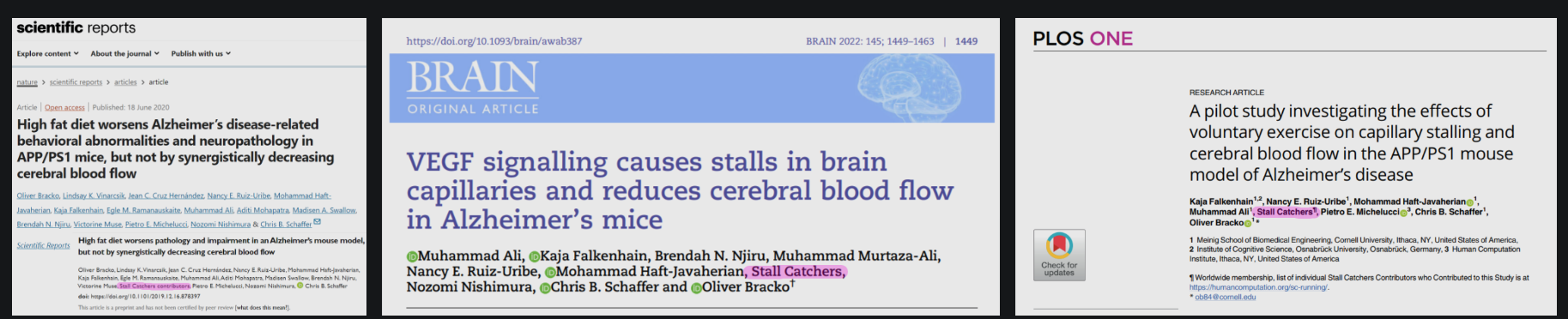
- “High fat diet worsens Alzheimer’s disease-related behavioral abnormalities…” (Scientific Reports, 2020): Stall Catchers volunteers analyzed ~96,000 capillaries; the study found that a high-fat diet worsened Alzheimer’s-related pathology in mice but did not further reduce cerebral blood flow. Read the paper
- “A pilot study investigating the effects of voluntary exercise…” (PLOS ONE, 2020): Volunteers analyzed ~26,000 capillaries; exercise improved several Alzheimer’s-related outcomes in mice but did not significantly reduce capillary stalls. Read the paper
- “VEGF signalling causes stalls in brain capillaries…” (Brain, 2022): Volunteers classified ~60,000 capillaries; researchers found that blocking VEGF-A signaling reduced capillary stalls and improved cerebral blood flow in Alzheimer’s-model mice. Read the paper
The project keeps getting better, too. Recent updates include a new progress bar so you can see how much of a dataset has been classified, faster transitions between movies, and a smoother mobile layout.
Whether you have five minutes or an hour, every classification adds up.